Non-invasive battery-powered energy logger — measures a single-phase home system without touching the wires.
EnergySnap is an open source energy logger for single-phase homes: a battery-powered, portable device that measures your electricity consumption without touching the wires. It clips onto the main cable with a current clamp, logs data to a microSD card for anything from one day to several weeks, and transfers it via Bluetooth to a desktop app for analysis. No cloud, no subscriptions, no electrician-level installation.
Schematics (KiCad), BOM and firmware are fully documented and open, so anyone can build it, study it and customize it.
Clamp CT sensor, no wire cutting.
Two AAA cells, fully autonomous.
One sample per minute on internal microSD.
Download to the PC app at the end of the campaign.
EnergySnap was born for those who need real data, not estimates: leave it in the electrical panel for a few days or weeks, collect the data and analyse peaks, night-time consumption and hourly profiles. Compact, affordable and designed to be replicated — a complete maker project, from the schematic to the firmware up to the analysis app.

Professionals — solar designers sizing systems and storage on real consumption data; electricians diagnosing anomalous loads by observing the system for days; objective reports to hand to the customer, before and after the intervention.
Hobbyists & makers — understand how much and when your home really consumes, room by room; hunt down the “energy hogs” and standby loads that weigh on your bill; the perfect base for energy-monitoring and DIY home-automation experiments.
Why does it last so long? Between samples the ESP32 goes into deep sleep, and the microSD and analog front-end are powered off (power gating). Data is always safe on the card, even with a dead battery.
EnergySnap uses a non-invasive SCT-013-030 current transformer: you open the clamp, place it around the live conductor of your main line, and close it. Nothing is disconnected or cut. The clamp produces a small signal proportional to the current flowing through the cable.
An analog front-end biases the signal at half the supply voltage and filters it before it reaches the ESP32-WROOM-32E. The microcontroller samples the waveform, computes the RMS current and estimates the power drawn by the home. Every minute (configurable) it writes a timestamped record to a CSV file on the internal microSD card.
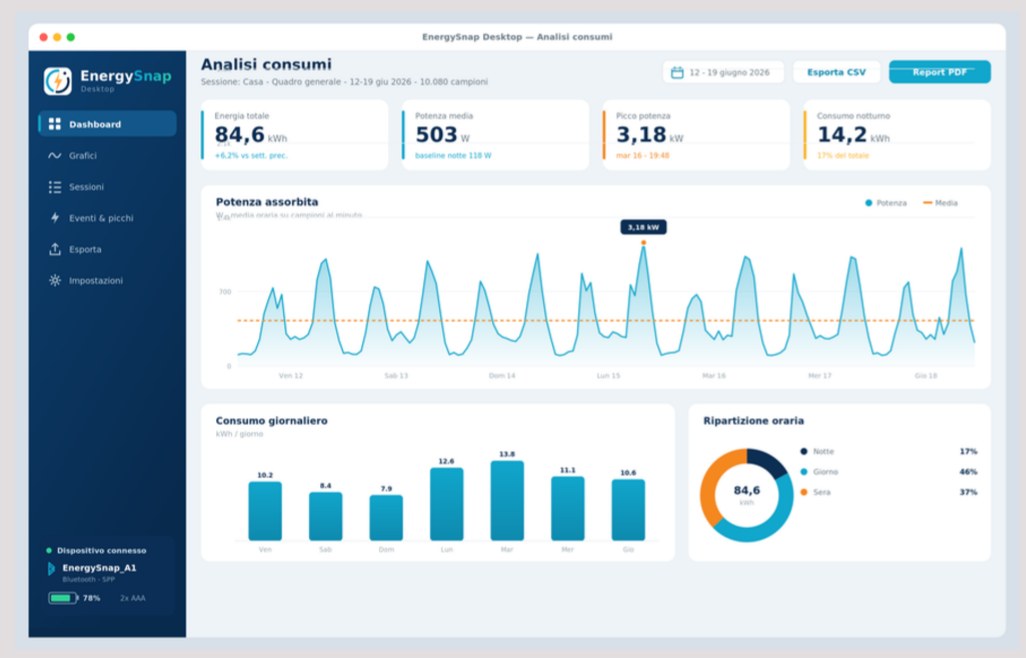
When the measurement campaign is over, you pair EnergySnap with your PC over Bluetooth Classic and download the data into the EnergySnap Desktop app, which turns raw samples into charts, daily totals and hourly breakdowns.
All data stays with you: the CSV files can be exported, shared or opened in any spreadsheet.
EnergySnap is a complete open hardware project. The KiCad schematics, PCB files, bill of materials, firmware and desktop app are all published on this page, so you can order the boards, solder the components and flash the firmware yourself, or study the design and adapt it to your needs.
The design deliberately uses common, affordable parts: an ESP32 module, a standard SCT-013 clamp, two AAA batteries and a microSD card. It is a good project for makers who want to learn analog signal conditioning, low-power firmware design and Bluetooth data transfer on a real, useful device.
Do I need to cut or disconnect any wires?
No. The current clamp closes around the existing cable. However, the main cable is usually inside the electrical panel: if you are not comfortable opening the panel cover, ask a qualified electrician to place the clamp for you.
How long do the batteries last?
About 56 days with one sample per minute, and up to roughly 8.5 months in power-saving mode, on two AAA alkaline cells.
Does it work with three-phase systems?
EnergySnap is designed for single-phase home systems (230 V / 50 Hz). Three-phase installations would require one clamp per phase.
Does it need Wi-Fi or a cloud account?
No. Data is stored locally on the microSD card and downloaded via Bluetooth. Nothing leaves your home unless you decide to share it.
Can I modify the firmware?
Yes. The firmware is open source: you can change the sampling interval, the file format or add new features.
All materials are open: download them, study them, customize them.
License: Hardware: open (KiCad) — Firmware: open source — Documentation: open
Leave your email to stay updated on Open Hardware Lab projects. Under no circumstances will your contact be used for external advertising.